
A personal reflection on Jibanananda Das, his haunting metaphors, solitary mind, poetic genius, and why reading him feels almost psychedelic.
I’d be lying if I said I had been meaning to write about Jibanananda Das for a long time, or that I read him every day. I don’t. Yet his books are never too far from me. They rarely stay neatly arranged on my library shelves because I have a habit of keeping one close to wherever I read or sit quietly with a cup of coffee. And still, months pass without my opening them.
Then, without warning perhaps on a wild night when the south wind reminds me of Hawar Raat, or while wandering through an old poetry website I find myself reaching for Jibanananda again, almost as if I have been called rather than persuaded.
Watching Bonolata Sen recently reminded me why.

Not because I thought it was a perfect film, it felt fragmented, lacks a connecting thread and at the end too lengthy. It wasn’t my admiration for its cinematic language or the drama it tried to bring. What remained with me was something else entirely: the unmistakable feeling that someone loved Jibanananda Das enough to attempt the impossible. The film felt less like an act of filmmaking and more like an act of longing. It was as though the director had spent years trying to understand what moved inside the poet’s mind and eventually accepted that he never fully could but made the journey anyway. That, to me, was the most moving part of the watching.
There is another work of art that unfailingly sends me back to Jibanananda Das, Kabir Suman’s song Shikarir Khoje. Suman draws directly from the poet’s world, weaving together his words, metaphors, images, and echoes of his poems into something that feels less like a song and more like a conversation across time. Without knowing Jibanananda Das, one can certainly appreciate the melody, but much of its emotional and literary depth remains hidden. It is only when you have wandered through Jibanananda’s poems that Shikarir Khoje reveals itself fully not simply as a song, but as an intimate homage to one of the most singular minds in Bengali literature.
Perhaps that is the only honest way to approach Jibanananda Das. Because I find him impossible.
Not difficult. Not obscure. Impossible.
There are poets whose worlds you eventually learn to navigate. You begin to recognize their patterns, their obsessions, their favorite images. They become familiar, almost domestic. Jibanananda refuses domestication. Every time I think I understand him, he quietly walks away into another twilight field, another lonely road, another forgotten river. That, I think, is why he can’t be read everyday. You read a few pages before bed and return to them casually next morning. Not Jibanananda. You have to clear a space inside yourself before opening one of his books. You cannot bring noise to him because he will not compete with it. Some times, you need to read a loud so you can better understand him.
I first encountered him in college. Like many students, I began enthusiastically. I thought I would read one poem after another until I understood why everyone called him extraordinary. Instead, I found myself closing the book not because I disliked it, but because I could not hold it. There was simply too much happening beneath the surface. Every image seemed connected to another invisible image. Every silence appeared to contain another poem that had not yet been written. Reading him continuously felt overwhelming, almost physically exhausting.
Years later, I realized that nothing had changed. I still cannot read him for very long, and perhaps that is exactly how he should be read. People often describe him as melancholic, solitary, depressive or withdrawn. Those words are not inaccurate, but they are incomplete. Depression alone does not produce great poetry. Loneliness alone does not transform language. Countless people have suffered, yet very few have changed the way an entire language imagines its landscape.
The Impossible Genius of Jibanananda Das
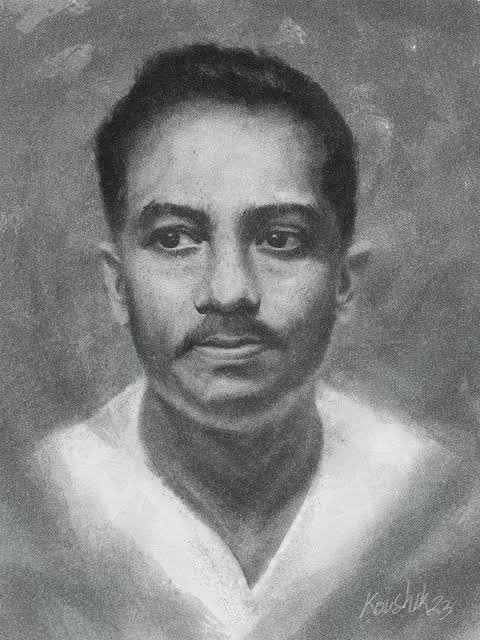
What fascinates me most is the way he looked at the world. Most poets search for beauty where beauty has already been agreed upon: flowers, moonlight, rivers, lovers. Jibanananda does something altogether stranger. He notices the owl before the moon, the bat before the sunset, the frog before the lotus, the porcupine, the mouse, the abandoned road, the neglected field, the smell of damp earth after evening.
His imagination refuses hierarchy. Nothing is too insignificant to become poetry, and nothing is too ordinary to become mysterious. He gives dignity to creatures literature had mostly ignored. That is not merely originality. It is an entirely different way of seeing.
After reading him, dusk never feels quite the same again. A lonely road is no longer empty. A bird crossing the sky becomes a philosophical question. Even silence begins to acquire texture. He changes perception itself. Perhaps that is why reading him feels, to me, almost psychedelic. I do not mean hallucination. I mean transformation. Something similar I feel when I read Sylvia Plath. That is why I often joke that reading Jibanananda intensely is like taking a psychedelic journey without drugs. You do not escape reality; reality simply becomes stranger.
Many readers find comfort in literature. I do not think Jibanananda offers comfort. He offers awareness, and awareness is not always pleasant. He reminds us that beauty and decay coexist, that desire and loneliness occupy the same room. People often compare him with nature writers, but I find that description too narrow. Nature, in his poetry, is never merely external. It is internal, remembered, imagined, and sometimes even invented. His Bengal is not simply a place you can visit; it is a landscape that exists somewhere between memory and dream.
When I say that reading Jibanananda Das feels almost psychedelic, I do not mean anything literal. There are no hallucinations, no distortions of reality in the obvious sense. What changes is perception. Language begins to loosen its grip on certainty. Words stop behaving in predictable ways. You start to feel that the poem is not just describing the world, but altering the way you experience it.
Jibanananda Das, Bibhutibhushan and Two Different Bengals
আবার আসিব ফিরে ধানসিড়ির তীরে — এই বাংলায়
হয়তো মানুষ নয় — হয়তো বা শঙ্খচিল শালিকের বেশে;
হয়তো ভোরের কাক হয়ে এই কার্তিকের নবান্নের দেশে
কুয়াশার বুকে ভেসে একদিন আসিব এ কাঠাঁল-ছায়ায়;
To understand Jibanananda Das better, you may bring him against the mirror of BibhutiBhushan. It is tempting to place Jibanananda Das alongside Bibhutibhushan Bandyopadhyay because both wrote so deeply about Bengal. Both bothered to amplify the smallest emotions or creatures around. Yet the resemblance is only superficial. They walk through the same land, but they do not see the same world.
বর্ষার দিনে এই ইছামতীর কূলে কূলে ভরা ঢলঢল রূপে সেই অজানা মহাসমুদ্রের তীরহীন অসীমতার স্বপ্ন দেখতে পায় কেউ কেউ..কত যাওয়া-আসার অতীত ইতিহাস মাখানো ঐ সব মাঠ, ঐ সব নির্জন ভিটের ঢিপি–কত লুপ্ত হয়ে যাওয়া মায়ের হাসি ওতে অদৃশ্য রেখায় আঁকা। আকাশের প্রথম তারাতা তার খবর রাখে হয়তো। – ইছামতী
Bibhutibhushan walks through Bengal with wonder. His forests breathe. His rivers nourish. His villages feel inhabited by quiet joy and a sense of divine presence. Even when there is hardship, there is also a kind of innocence that softens it. His Bengal is alive in a way that invites you in.
Jibanananda walks through Bengal after dusk. It is filled with returning birds, fading light, abandoned roads, and names that seem to belong to another century. There is beauty, but it is tinged with distance. There is life, but it feels as though it has already passed. His Bengal is not something you enter; it is something you recall.
Interestingly, many readers feel they belong together. Reading Bibhutibhushan often makes one want to read Jibanananda, and vice versa. One gives you the physical Bengal; the other gives you its inner weather.
Why Jibanananda Das Reminds Me of Van Gogh
I often find myself thinking of Van Gogh when I read Jibanananda Das. Not because of biography, not because of suffering, but because of perception. Van Gogh painted wheat fields. Many painters painted wheat fields. Yet after Van Gogh, wheat could never again be merely agriculture. It became movement, emotion, turbulence, light.
Similarly, many poets wrote about Bengal, nature or desire in Bangla literature. After Jibanananda Das, Bengal could never again be merely geography. It became memory, solitude, time, and something almost metaphysical. Van Gogh painted crows until they carried unease, urgency, and a strange kind of beauty. Jibanananda wrote about owls, bats, frogs, mice, and evening birds until they became philosophical presences. Neither artist beautified the world in the conventional sense. They intensified it.
Yet there is also a difference. Van Gogh’s paintings often feel like they are reaching outward, almost asking to be seen, to be understood, to be loved. Jibanananda’s poems do not ask. They simply exist. Van Gogh strikes me as heartbreakingly tender, almost childlike in his longing to love and be loved. Jibanananda feels different, quiet, hauntingly quiet. Less eager to be understood. If Van Gogh opens his wounds to the world, Jibanananda walks deeper into the forest burying his inside his heart.
Writers remain on our bookshelves. Jibanananda Das remains somewhere behind the mind itself, waiting quietly until one fading evening, a bird crosses the sky or a sudden gust of wind touches your face. Then, without warning, a forgotten line returns. Only then do we realize that we never truly stopped living inside his pages, nor did he ever stop living inside us.
সমস্ত দিনের শেষে শিশিরের শব্দের মতন
সন্ধ্যা আসে; ডানার রৌদ্রের গন্ধ মুছে ফেলে চিল;
পৃথিবীর সব রং নিভে গেলে পাণ্ডুলিপি করে আয়োজন
তখন গল্পের তরে জোনাকির রঙে ঝিলমিল;
সব পাখি ঘরে আসে— সব নদী— ফুরায় এ-জীবনের সব লেনদেন;
থাকে শুধু অন্ধকার, মুখোমুখি বসিবার বনলতা সেন।


