Explore Rumi through love, longing, Shams of Tabriz and the Buddha—an intimate reflection on mysticism, ego, awakening and the Divine Beloved.
Zabān-e-yār-e-man Turkī wa man Turkī namī-dānam.
The language of my beloved is Turkish, and I do not know Turkish.
There is an old Persian line, commonly circulated in the orbit of Amir Khusrau, that has stayed with me for years because it describes something far larger than the inconvenience of not knowing somebody’s language. It describes the strange predicament of love itself: the beloved speaks, you do not entirely understand, and yet something in you understands before understanding becomes language.
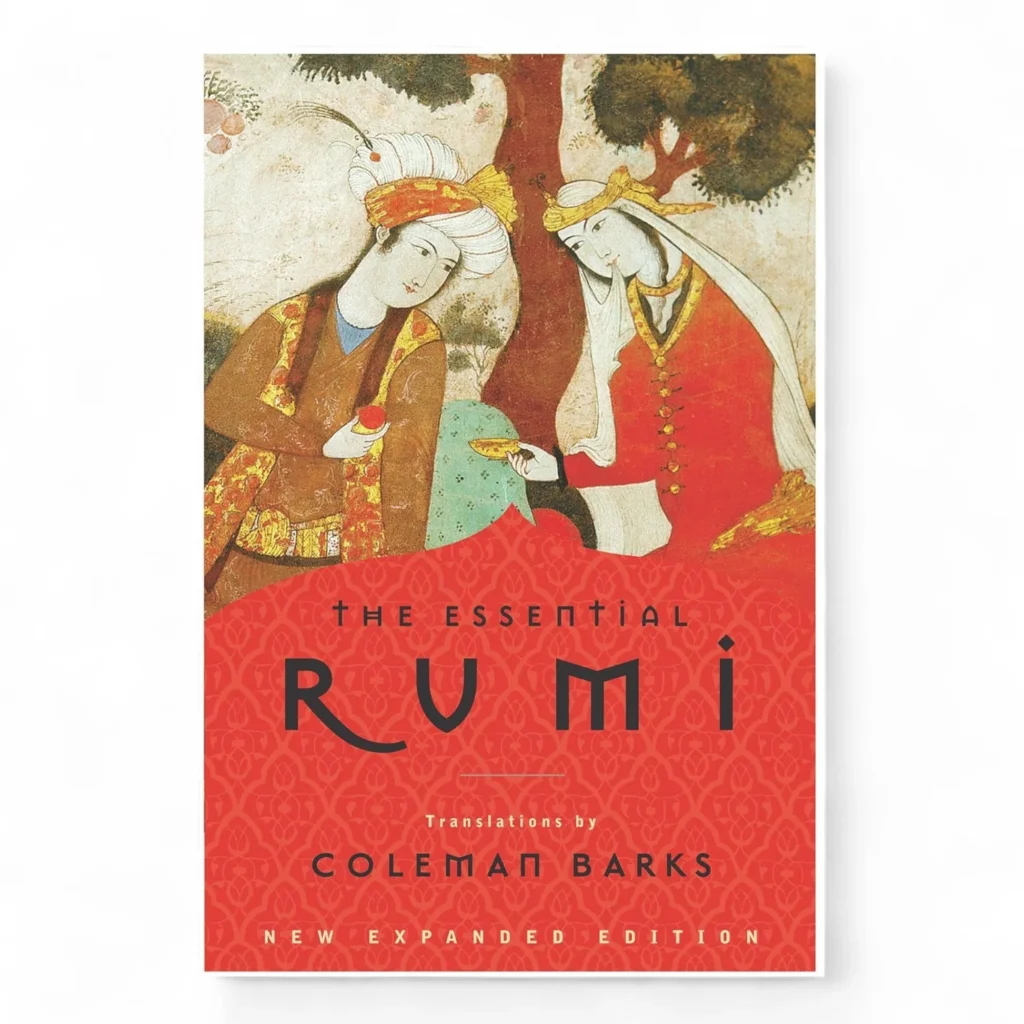
I do not know Persian. I cannot enter his poetry through the door through which it was written. I come to him second-hand, sometimes third-hand, through translation, interpretation, fragments, quotations, books, and most memorably through Coleman Barks. There is a certain irony in this, because Barks himself did not translate Rumi directly from Persian, and his enormously popular versions have been criticised for removing much of Rumi’s Qur’anic and Islamic vocabulary. The Rumi many of us first met in English is therefore not quite the complete historical Rumi. The real Jalāl al-Dīn Muhammad Balkhī was not a vaguely scented New Age philosopher floating above religion. He was a Muslim scholar, teacher and Sufi whose mystical imagination grew from within Islam.
And still — zabān-e-yār-e-man…
I do not know his language. Somehow, I know something of what he is saying.
Rumi has been somewhere in my interior landscape for a very long time. I have opened his poetry blindly on happy days, almost as a private ceremony of gratitude. I have reached for him in grief. I have gone looking for him when my mind was noisy and when life felt strangely empty. There are poems I return to again and again, not necessarily because I understand them better each time, but because I am different each time.
Recently I have been reading Elif Shafak’s The Forty Rules of Love, and it has disturbed something pleasantly dormant in me. I say disturbed deliberately. Some books entertain us; some educate us; a very few walk into abandoned rooms of the mind and open the windows.
It has been touching those sleeping spaces in me that had gone quiet from lack of watering. Ideas I thought I had settled have begun moving again: love, surrender, ego, God, longing, solitude, spiritual companionship, the peculiar human habit of building walls around precisely the things we most desire to encounter.
And behind all of this stands Rumi.
The Guest House – Rumi [A poem I recite like a prayer]
It is easy to turn Rumi into legend because history itself seems to have arranged his life like a parable.
Born in 1207, probably in or around Balkh, Rumi came from a family of religious learning and eventually settled in Konya in Anatolia. He became a respected scholar and teacher. He had students, responsibilities, learning, authority. He possessed, in other words, many of the things by which respectable society recognises a successful man.
Then, in 1244, Shams of Tabriz arrived. And the scholar caught fire. Historical sources describe Shams as an itinerant mystic who profoundly redirected Rumi’s spiritual life. Their encounter was so transformative that Rumi’s great lyric collection would eventually bear Shams’s name: the Divan-e Shams-e Tabrizi. After Shams disappeared, around 1247, Rumi’s longing did not disappear with him; it became poetry.
People have spent centuries asking what exactly Shams was to Rumi. Teacher? Spiritual master? Friend? Beloved? Mirror? The great destabilising force of his life? Perhaps our modern obsession with naming relationships makes the question smaller than the relationship.
And perhaps this is one of the most frightening forms of love: not the person who completes you, but the person in whose presence you can no longer remain who you were.
My Eight-Hundred-Year-Old Lover
I have, I confess, a lover-like feeling toward Rumi. Not romance in its ordinary sense. Something stranger. Or may be rommance, I can’t say. I recognise in him a kind of madness I understand: the refusal to love politely.
Rumi’s spiritual universe is excessive. He does not appear particularly interested in lukewarm enlightenment. He wants burning, drowning, vanishing, intoxication, bewilderment. He wants the small fortified self demolished so that something immeasurably larger can enter.
Perhaps this is why, more than eight centuries after his birth, people still pass his words from hand to hand. Although, admittedly, we have become rather inventive about what we do with them.
The internet has performed its own small miracle upon Rumi. A thirteenth-century Muslim mystic can now be found underneath photographs of cappuccino foam, sunsets in Bali and couples holding hands beside infinity pools.
Someone posts a line about annihilation in the Divine Beloved. Then tags her boyfriend. Rumi spent a lifetime trying to dissolve the ego into God, and somewhere on Instagram the result is: @LoverBaby this is literally us.
One suspects Maulana might require a moment.
This is not to say that Rumi cannot speak to human love. Of course he can. Sufi poetry deliberately plays with the instability between lover and Beloved, desire and devotion, earthly beauty and divine beauty. But reducing every Rumi poem to romantic coupledom is like finding an ocean and using it to fill a decorative birdbath.
The boyfriend may be lovely. He is simply not always the Beloved Rumi talks about.
And this distinction matters because Rumi’s power comes precisely from his refusal to leave love at the scale of personal possession. Love is not merely I want you. It is the terrifying possibility that the “I” doing the wanting may itself have to change.
Where Rumi Meets the Buddha — and Where He Does Not
Perhaps because I encounter Rumi from within my own Buddhist sensibility, I often feel an unexpected familiarity in him. Or I match the men and try seeing if there is a pattern.
The Buddha and Rumi stand seventeen centuries apart. Their religious cosmologies are profoundly different. Buddhism does not posit the creator God whom Rumi adores. Rumi’s mystical path unfolds through Qur’an, Prophet, prayer and the Sufi longing for God. To pretend that these differences do not matter would flatten both traditions into the modern spiritual smoothie in which everyone secretly taught exactly the same thing.
They did not. And yet they sometimes arrive at startlingly adjacent doors. The Buddha’s teaching of anattā dismantles our attachment to a permanent, independent self. Our clinging to “I,” “me” and “mine” helps generate craving, fear and suffering; liberation requires seeing through that attachment.
Rumi also distrusts the little sovereign self. In Sufi language, fanā points toward the passing away or annihilation of the ego-self in relation to the Divine. But this is where the similarity must be handled delicately. Buddhist anattā is not simply another name for Sufi fanā, and Nibbāna is not a Buddhist synonym for union with God. Their metaphysics are different.
The Buddha approaches with extraordinary lucidity. Observe. See craving arise. See it pass. Notice impermanence. Stop grasping. The path is disciplined, penetrating, almost surgical in its examination of suffering. Rumi comes dancing through another door. Burn. Lose yourself. Become empty enough for the Beloved. The Buddha sometimes feels to me like clear water. Rumi feels like wine. One sobers me into freedom; the other intoxicates me out of captivity.
And somewhere beneath the difference, I hear a related warning: much of what causes us suffering comes from our desperate defence of the person we imagine ourselves to be.
Human beings are talented that way. We can make an identity even out of having transcended identity. Sometimes awakening is not addition. It is subtraction. The Buddha understood this. Rumi understood it differently. And somewhere between the Buddha’s silence and Rumi’s ecstatic music, I find a territory I recognise.
Perhaps that is also why Rumi remains my impossible, eight-hundred-year-old lover. I do not understand everything he says. I am not even hearing him in his own language. But every now and then, through the imperfect window of translation, something reaches me intact. Something ancient and almost embarrassingly alive. It touches one of those unwatered places in the mind and suddenly there is movement there again.